Sewer Line Replacement and Trenchless Pipe Lining in Fort Mill, SC
When the whole run is failing, there are three main ways to get a new pipe. The ground, the old pipe and what's built on top decide which one fits.
Call to check availability
Open trench
Excavates the entire run; best for backward sags or collapsed lines needing new slope.
Pipe lining
Cured-in-place epoxy creates a seamless new pipe inside the old line with minimal digging.
Pipe bursting
Pulls full-diameter seamless HDPE through the brittle pipe, fracturing it outward safely.
When the camera shows a line that's failing along most of its length, Sewer Line Repair in Fort Mill, SC turns into a choice between digging a new pipe in and building a new one inside or through the old one. Where mature trees, paved driveways, or deep foundations sit directly over the route, trenchless technology preserves your landscape while restoring vital municipal grade sewer performance.
When Does a Sewer Line Need Full Replacement?
Replacement or lining is usually the answer when damage is spread along the line: Orangeburg pipe that has flattened, clay pipe with roots at many joints, heavily corroded cast iron, or repeated backups after earlier spot repairs. One bad section usually just needs a repair.
If your diagnostic video footage isolated only one cracked hub or shallow root cluster, a spot repair is typically the most economical solution. Full replacement becomes necessary when the structural integrity of the entire conduit has eroded past localized remediation.
Open Trench, Pipe Lining or Pipe Bursting: What's the Difference?
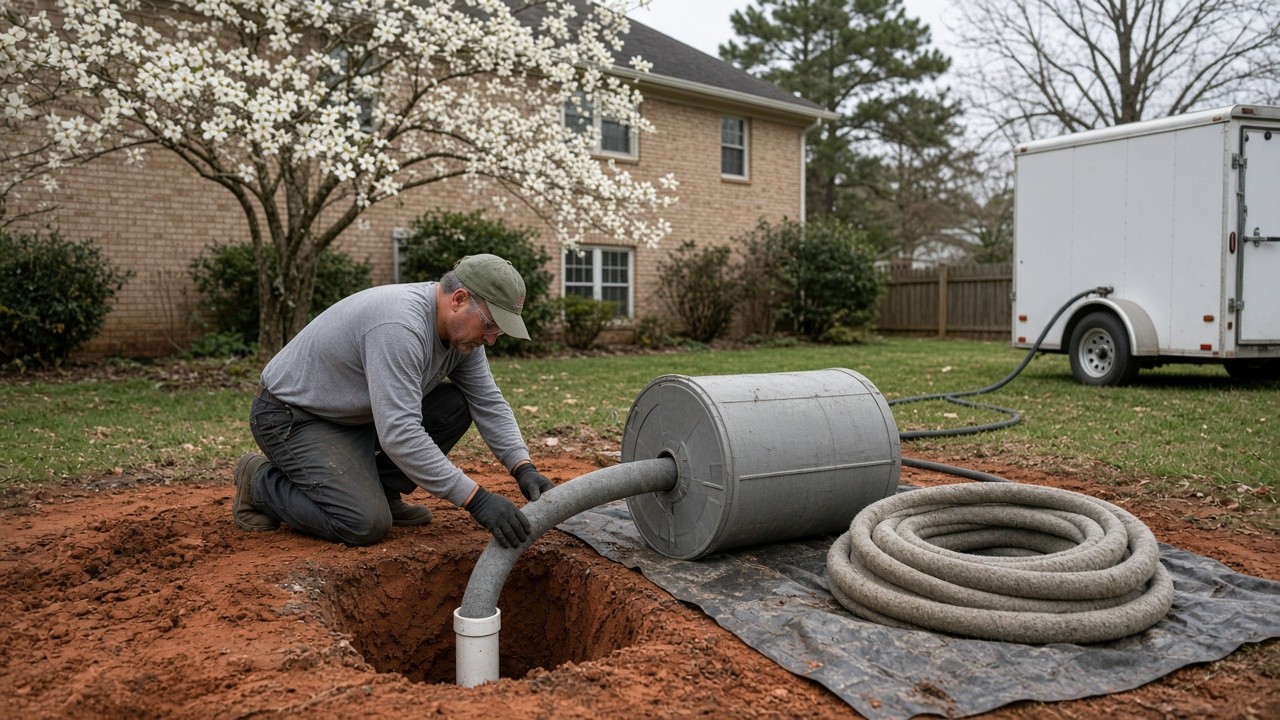
Open trench digs out the old pipe and lays new PVC along the entire ditch. Pipe lining inserts a flexible resin tube inside the existing pipe that hardens into a smooth liner without open digging. Pipe bursting pulls brand-new pipe through the old line while fracturing the brittle host pipe outwards.
| Criterion | Open trench | Pipe lining (CIPP) | Pipe bursting |
|---|---|---|---|
| How it works | Excavator digs full trench; pipe laid on stone bedding. | Epoxy tube inverted into host pipe and cured in place. | Expanding conical head fractures old pipe, pulling HDPE behind. |
| Digging needed | Continuous open trench along full lateral run. | One or two small insertion pits (often existing cleanout). | Two access pits: insertion pit and pulling pit. |
| Good fit | Severe backward sags, collapsed pipe, shallow open yard. | Pipes with sound round shape under driveways or trees. | Brittle clay or cast iron along same straight route. |
| Watch-outs | Disrupts turf, roots, hardscaping, and concrete surfaces. | Slightly reduces inside diameter; cannot fix back-slope sags. | Cannot be used too close to parallel buried utilities. |
| Price basis | Roughly $50–$250/ft (plus restoration) | Roughly $80–$250/ft | Roughly $60–$200/ft |
The camera footage and the site decide which method fits.
Told you need a new line?
Call and we'll walk through which method fits your yard and why.
Call (803) 887-3236How Much Does Sewer Line Replacement Typically Cost in Fort Mill, SC?
Open-trench replacement is often quoted at roughly $50–$250 per foot, with whole jobs commonly several thousand to $15,000 or more; lining runs roughly $80–$250 per foot and pipe bursting roughly $60–$200 per foot. Permits and restoration add to the total. Typical ranges, not quotes.
What Happens to the Yard and Driveway?
Open trench means a trench along the line and restoration of lawn, beds or concrete afterward; lining and bursting usually need only one or two small access pits, so driveways and mature trees can often stay.
Carolina Piedmont red clay compacts differently than sandy soil. When trenches are cut, clay must be returned in tamped lifts to prevent long-term ground depression. With trenchless CIPP lining, access pits are small, preserving decades-old hardwoods, brick walkways, and paved driveways that would cost thousands to replace.
For homeowners exploring nearby town guidelines, see our dedicated coverage for sewer line repair in Tega Cay and sewer line repair in Indian Land. Every project begins with a clear camera inspection and hydro jetting evaluation.
Frequently Asked Questions About Replacement & Lining
How long does a lined pipe last?
+−
Liner manufacturers and independent test labs describe a 50-year design life for epoxy-cured structural sleeves. Actual longevity in the field depends on proper surface preparation, host pipe geometry, and professional cure monitoring, without any lifetime promises.
Can you line a pipe with a belly?
+−
No. Cured-in-place lining conforms exactly to the contours of the host pipe. If your lateral pipe sags or dips backwards in settled red clay, the new epoxy liner will follow that exact dip and continue holding standing water. A severe belly requires an excavation repair to regrade.
Does pipe lining work on Orangeburg pipe?
+−
Only if the bituminized fiber conduit remains structurally round and has not suffered delamination or flattening. If the Orangeburg line has collapsed into an oval or choked down, pipe bursting or open-trench replacement is usually necessary.
Will I need a permit?
+−
Yes. Complete sewer line replacements and trenchless structural rehabilitation projects commonly require a plumbing permit and subsequent municipal or county code inspection across York and Lancaster counties.
Can I use the plumbing during the work?
+−
Water usage must be paused during active pipe rehabilitation. With trenchless pipe lining, service is typically restored within a single workday once the resin cures, whereas multi-day open-trench projects require temporary staging.
Question not covered here? Call (803) 887-3236